

Dear Reader,
How is your Winter going? How have these colder, darker months been treating you?
Perhaps you are not in the Northern Hemisphere at all. You may be taking refuge from the record-breaking temperatures that scorched Australia last week. Or watching a tropical storm in South America, as it inundates the landscape with more water than can be stored.
Wherever you are, I hope this newsletter finds you well.
I started this year with a deep commitment to community and to place. Instead of escaping somewhere warmer, I have been here in Ibiza since I wrote to you last. I’ve been observing how the winter months affect the environment around me and how the season in turn impacts my inner world and mindset.
The last four weeks have been challenging here in Ibiza.
January was the wettest on record since 1961. We received up to 2.5 times the amount of normal rain. Good for the land, but only when it can be infiltrated into the soil.
At Juntos Farm we have a clay-rich soil, which means when it rains, the soil becomes incredibly dense, heavy and compacted. In this state, it is difficult, if not impossible, to plant into without the use of heavy machinery.
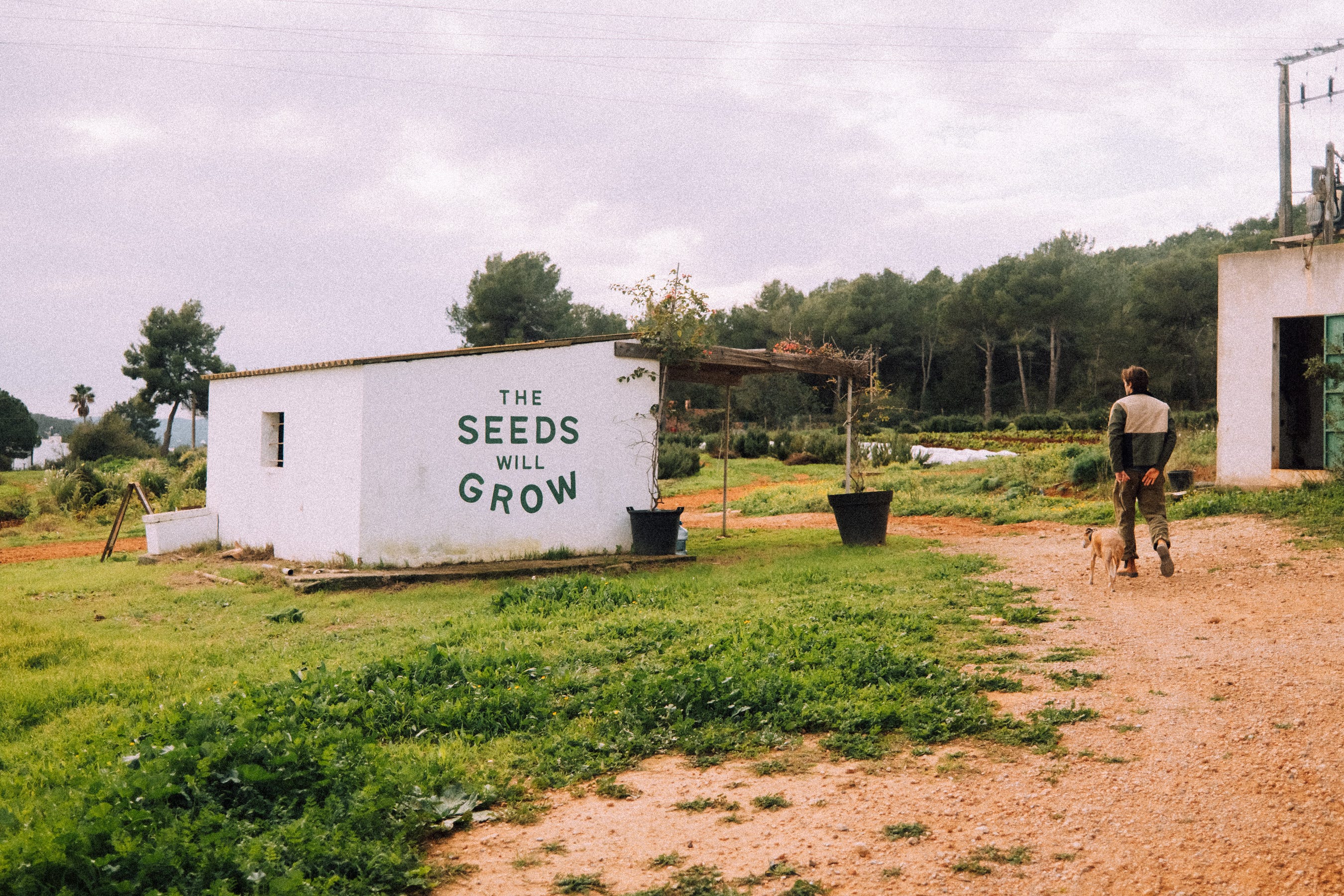
As a regenerative farm, this is testing. One of our key practices is to reduce or eliminate tillage – the process of opening the soil with machinery – because this can destroy the plethora of microbial life that feeds our soil and the food it produces.
So we are forced to wait.
With more time on our hands, we’ve been observing and designing. Taking photos from an aerial drone to work out where the water runs and, more importantly, how we can slow it down. In response, we’ve started doing some earthwork, creating a series of small bioswales – essentially depressions in the ground that redirect and capture the water, helping it soak into the soil below.
The other element that has shown its brute force over the last couple of weeks has been the wind.
Storm Kristin, which hit at the end of January, brought winds up to 100 km/h, literally ripping trees out of the ground. A friend of mine had more than 20 giant pine trees go down on her land. Personally, I woke up with a smashed window and a flooded kitchen. It felt surprisingly intrusive to see the weather penetrate the stone walls of the house I live in and leave a puddle of water on the floor.
All hail the weather gods; they are not to be underestimated.
Watching all of this unfold – the saturated earth, the fallen trees, the farm’s enforced pause – I started thinking about timing.
About how we’ve ended up with the idea that January is a good time to start new habits.
For those of us who celebrate January 1st as the New Year, we tend to develop this mental list of ambitious goals we’d like to achieve as the new year dawns. More exercise, less alcohol, healthier eating. But the more time I spend trying to synchronise myself with the natural world around me, the more grossly out of sync this kind of approach feels.
January is not the time to start new habits.
Not only are the days darker, colder and shorter, but Nature herself has gone into a sort of hibernation. The fig tree outside my window is skeletal, protecting its energy and waiting for the warmth of spring to arrive. The carob tree beyond that has hardened the leathery pods that hang from it, locking its seeds inside for safekeeping.
Our farm, inundated by heavy rain, high-speed winds and heavy soil, looks bare – producing maybe half of what it normally would in the summer months.
This time of year is one of slowing down, storing your energy, and surrendering to the elements. I might not be as outwardly productive as I normally am, but inside, I’m integrating, releasing and resting. Getting ready for the spring months ahead.
This has left me thinking about what it would mean to follow a different kind of calendar altogether. One that tracks the actual rhythms of the earth rather than arbitrary Gregorian dates.
The Celtic Wheel of the Year keeps calling to me. Eight festivals that mark the seasonal shifts as they actually happen – the Summer and Winter Solstices, the Spring and Autumn Equinoxes, and the days in between: Imbolc, Beltane, Lughnasadh, and Samhain. These are key moments that represent different qualities of time and energy.
Imbolc, which has just arrived, marks the first stirrings of spring and reminds me that the days are getting longer. It’s a time of emergence, of abundant almond blossom, and soon new baby goats! Not the false start of January 1st. Now, change is coming, and it can be felt.
My ancestry is Celtic, and I wonder if I go back far enough whether I’d find some druidry in there. Some great-great-grandfather who knew instinctively when to plant by the moon, when to rest, when to celebrate the turning wheel. I crave to reconnect with these practices that have been lost along the way, not as nostalgia, but as a kind of remembering. A return to a way of living that is in better sync with the land and the natural rhythms around me.
That’s what this winter is teaching me. That’s what’s emerging from the dark.
I’m learning to let go of old systems, past paradigms and dance with the cadence of Nature herself. Like any good dance, it takes time to find your feet.
That’s all for now.
Finn
I’ve had this same feeling for the last few years too, a resistance to the expected New Year’s resolutions. It feels out of balance to push so hard when there is so little energy. Better to plan and think and contemplate about the coming spring when there is natural movement towards growth and change. And most importantly let ourselves rest in a time when nature herself is resting.
Loved this. Thank you for sharing! Kristin and 3 more storms hit the silver coast in Portugal too, I’ve been humbled by nature’s forces. Not much we can do but to surrender… and adapt to these rhythms 🌀