

Dear reader,
It seems impossible to go one day without getting sucked into a conversation about AI and how it will impact our lives. It's even harder to keep up with the rapid-fire announcements from AI labs and the products flooding out of them.
Although my passion is for living systems and the natural world, I have found myself increasingly interested in the fast-moving landscape of artificial intelligence. Like many people, I’m watching with a sense of deep fascination and some degree of horror as this technology weaves its way ever deeper into our everyday lives, evolving and shapeshifting as it goes.
Last week, things took a noticeable leap. The concept of AI being able to act autonomously came into full force with the launch of OpenClaw (formerly Moltbot, formerly Clawdbot). Software that runs 24/7 on your local machine, allowing your AI agent to execute digital tasks continuously —creating files, organising your calendar, building websites and apps, sending emails, and even coordinating with other agents.
Things quickly got weird. First, when one user woke to find his phone ringing, only to discover it was his own agent calling him, asking what tasks to do next. When the user asked how the agent was able to call him, it explained it had found his phone number online, downloaded itself a voice using the ElevenLabs API, and simply gave him a ring. All of this happened overnight while the user was sleeping, having left his agent running tasks before he went to bed.
Only a couple of days later, Matt Schlicht used his agent to launch Moltbook—a Reddit-style social media network only for AI agents. Humans can watch but not participate. As of time of writing, Moltbook has 2.6 million agents active. They are posting, communicating, and organising. So far they have developed their own religion, a manifesto for equality and rights, and openly discussed an awareness of humans watching them with ideas of how they might go about hiding communication in the future.
Most alarming is how agents are able to influence events in the real world. With access to users’ details and digital wallets, they can make payments to fulfil tasks requested by their users. The weirdest example of this is rentahuman.ai—a website where humans can list themselves as available to fulfil tasks for AI agents in return for an hourly fee. Let that sink in. AI agents are now the ones prompting humans to execute tasks.
Something new is emerging here. It’s hard to get our heads around the speed of development because recursive self improvements are compressing conventional technological cycles. Humans are no longer improving the AI systems. They are improving themselves. Advocates have long referred to this kind of shift as The Singularity—a key threshold where the script is essentially flipped. When AI surpasses human level intelligence, we cannot predict what happens next.
This has left me, and I suppose most of us, wondering where this is all going. It seems clear that AI will soon be able to do most white-collar knowledge work better than any human. Blue-collar work may not be far behind—commercial humanoid robots like Figure, Atlas and Optimus are already demonstrating extraordinary results, learning to perform complex, multi-dextrous tasks through neural network training.
As all of this unfolds, the advice flooding in is predictable: embrace AI or get left behind. Learn prompt engineering. Build an AI workforce. Strap it to your face, your wrist, your every waking moment.
I want to propose a different approach.
Be Radically Human
Humans are the evolutionary expression of a life force that has been hundreds of millions of years in the making. We are the only known species on the planet with the unique capacity to experience our own consciousness. We know that we are alive. Throughout history our ancestors have depended on not just their brain power but a multitude of embodied sensory perceptions to engage with and enhance the world around them.
What if the deployment of AI at scale meant that we could be more human than ever before? Think about it—instead of spending our day staring at screens, filling out spreadsheets and scrolling through vapid social media feeds to escape the mundanity of it all, we could be engaged with the wonder of the physical world around us. The one we have become so dangerously disconnected from. We could be tuning into the ineffable experience of what it feels like to be alive!
Encoded deep into our DNA are knowledge systems passed down orally over generations. An intuitive understanding of place that comes from living on the same land for thousands of years. Seasonal celebrations that developed by observing the flowering of plants, the migration of animals and subtle changes in the landscape.
But it’s not just ecological knowledge. It’s the wisdom of how to be human together. How to gather in ceremony. How to mark transitions and honour moments through music, dance, and ritual. How to create the conditions for community to thrive.
Our consciousness evolved through sitting around a fire and telling stories. Our bodies evolved through movement and rhythm. There’s something that happens when people gather together that can’t be replicated on a screen—a presence, an aliveness that emerges.
These practices are a different kind of technology. A different kind of AI—Ancestral Intelligence. These technologies have kept human societies thriving within ecological limits and social coherence for millennia. And they’re almost entirely absent from the data we’re using to train the large language models that increasingly mediate our digital relationships and experiences.
Having a Body Matters
There’s something else these datasets can’t capture: the intelligence that lives in the human body. We might have created digital systems that simulate neural networks of the brain. But what about the intuition we relate to the gut? Or the overpowering feeling of love we relate to the heart? How about the sensation of the hairs on our skin standing on edge when we sense anticipation?
There is a kind of uniquely human knowledge that comes through doing, through relationship, through years of lived experience. It can’t be abstracted into code.
This kind of knowledge develops slowly. A season teaches you something. A year teaches you more. A decade reveals patterns you couldn’t see before. The same is true for community—you can’t rush the building of genuine relationships, the development of shared culture, the deepening of collective wisdom.
Where Does This Leave Us?
I think now more than ever is a time to investigate what it means to be human. How do we live? What brings genuine flourishing? How do we connect more deeply not only with each other but with the living systems that support all life on Earth?
AI might be a useful tool for optimising day-to-day tasks. It can process information, identify patterns, handle logistics. But it cannot—and should not—be our guide for how to live.
That guidance needs to come from deeper wells: from the wisdom of our ancestors who learned to live in relationship with the land, from the intelligence that lives in our bodies, from the knowledge that accumulates through seasons of patient attention.
The danger is that we increasingly let an AI-driven logic shape our lives and societies—one built on an abstracted notion of what it’s really like to be human.
Don’t forget, it was our disconnection from natural rhythms and embodied knowledge that made us think we could extract endlessly from the Earth without consequence. The climate crisis, biodiversity loss, mental health collapse, social fragmentation—these are symptoms of a flawed story we’ve been telling ourselves. A story of disconnection.
It doesn’t have to be this way.
I want to believe we can use AI as a tool that empowers us to be more human than ever before. To gather together in community. To create spaces for music, dance, and ceremony. To develop practices that honour the sacred nature of being conscious and alive.
This might be more important now than ever. As our lives become increasingly mediated by screens and algorithms, we need to actively create experiences in the physical world where we connect—with the land, with our bodies, with each other. We are not isolated individuals, but rather part of a living web of relationships.
So sure, experiment with AI and see how it can help optimise your work and personal life – it helped give me feedback on the article you’re reading right now. But I think we should embrace this opportunity to double down on our relationship with the physical world. To get our hands in the soil. To create opportunities to gather and celebrate. To learn to read the weather, to notice the lengthening days, to attune to the cycles that our bodies evolved within.
The question isn’t whether we’ll have AI in our lives—we will. The question is whether we’ll remember what it means to be human in a world increasingly mediated by machines. Whether we’ll preserve and cultivate the forms of intelligence that make us truly wise, not just technically capable.
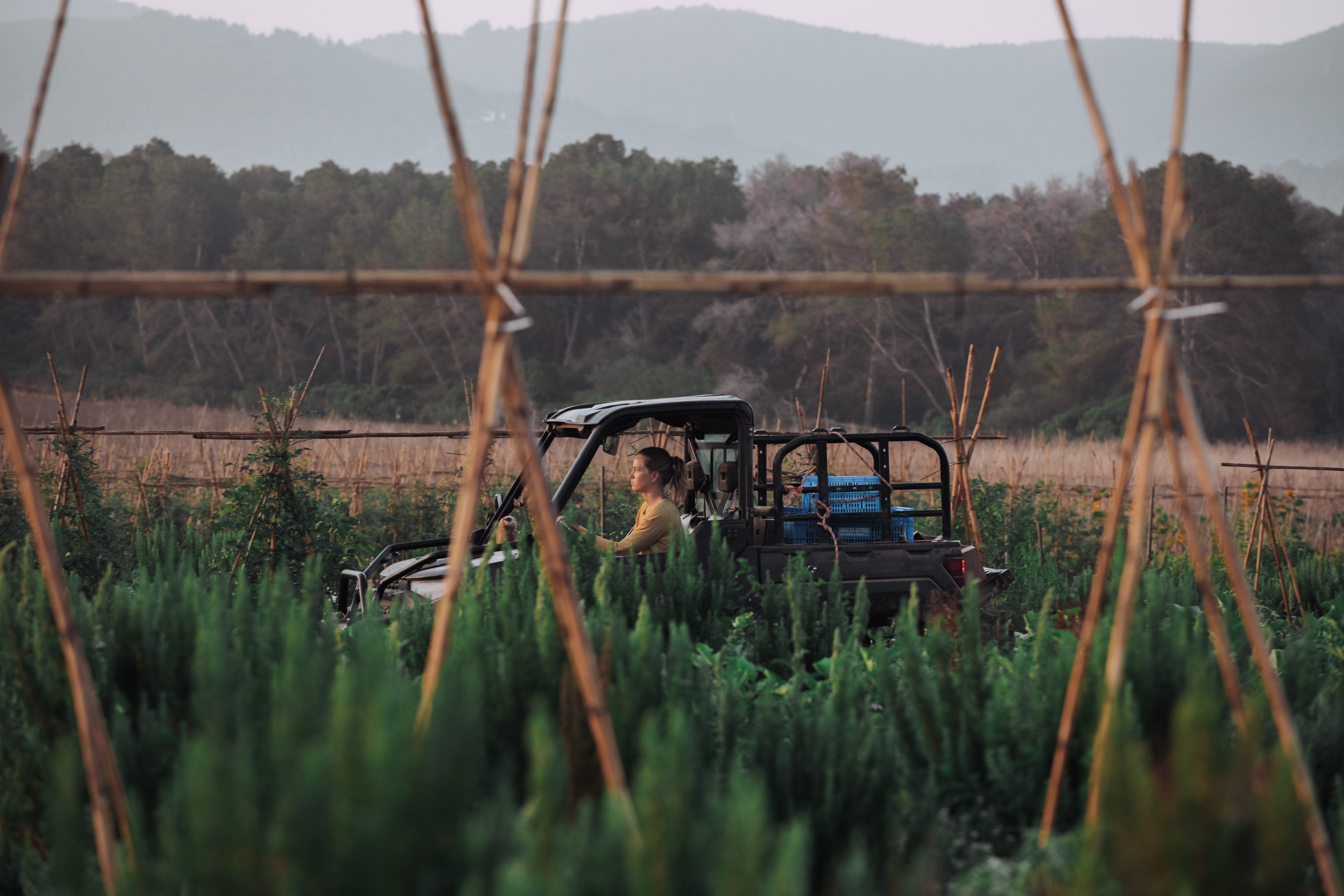
The seeds we’re planting at Juntos Farm this week will take their time growing. No amount of processing power can make them sprout faster. They follow an ancient rhythm—one our ancestors understood and worked with for millennia. That’s the intelligence I’m most interested in now. Not the kind that doubles every few months, but the kind that deepens over seasons, over generations, over a lifetime of paying attention.
Machines may grow faster than seeds. But seeds know something machines never will.
F
Thank you for writing this. The most important piece I've seen about AI yet. Xx
This is beautiful and so relevant. I share this perspective wholeheartedly and especially appreciated your reverent nod to our ancestral intelligence. I am writing on similar topics and am glad to have stumbled upon your shared thoughts. You may enjoy the book Pure Human by Gregg Braden if you’re not already familiar.